Table of Contents
Sifat al-Huruf: Complete Guide to the Characteristics of Letters in Tajweed
If you have ever listened to a master Qari recite the glorious Holy Quran and wondered why their recitation sounds so unbelievably rich, precise, and breathtakingly majestic, you are listening to the exact application of a highly advanced phonetic science.
Many adult students spend years agonizing over Makharij (the physical exit points of the letters), only to find that their recitation still sounds completely flat, foreign, or incorrect. Why? Because they are missing the second, infinitely more nuanced half of the Tajweed equation: Sifat al-Huruf (The Characteristics of the Letters).
Imagine two identical cars rolling off an assembly line. They originate from the exact same place, but one is painted black and driven aggressively, while the other is painted white and driven smoothly. In Arabic, many letters share the exact same physical exit point in the mouth. Without understanding sifat al huruf, it is physically impossible to differentiate them.
This ultimate, incredibly comprehensive, encyclopedic guide will brilliantly break down the exact difference between Makharij and Sifat, dissect the 5 pairs of opposing characteristics, explore the 7 unique unpaired characteristics, and help you unlock the true, majestic rhythm of the Quran.
What is Sifat al-Huruf? The Difference Between Exit and Behavior
Linguistically, the Arabic word Sifat (صِفَات) is the plural of Sifah, which translates directly to “characteristic,” “attribute,” or “quality.”
In the highly rigorous, deeply preserved science of Tajweed, sifat al huruf refers to the exact manner in which a letter is pronounced after it emerges from its Makhraj.
- Makhraj (The Where): Tells you exactly where to place your tongue or lips to birth the letter.
- Sifat (The How): Tells you how that letter should behave. Does breath flow or stop? Does sound echo or freeze? Is the letter heavy and thick, or light and sharp?
The Ultimate Proof: The Taa (ت) vs. The Taa (ط)
If you do not believe Sifat is absolutely necessary, look at the Arabic letters ت (light Taa) and ط (heavy Taa). Both of these letters originate from the exact same Makhraj: the tip of the tongue hitting the roots of the upper front teeth. If you only know the Makhraj, they will sound identical. However, the heavy ط has the Sifah (characteristic) of Isti’la (elevation of the back of the tongue), which makes it thick and booming. If you fail to apply this characteristic, you turn the heavy letter into a light one, committing a devastating phonetic error (Lahn Jali) that destroys the meaning of the verse.
(For a deeply fascinating academic breakdown of how phonetic attributes separate identical consonants in Semitic languages, research published by the Journal of Phonetics highlights the immense neurological and muscular control required to execute these traits).
The Two Major Categories of Sifat al-Huruf
Classical Islamic scholars, most notably Imam Ibn Al-Jazari, brilliantly organized all the characteristics of Arabic letters into two distinct, easy-to-understand categories:
- Sifat Mutadaddah (Characteristics with Opposites): Every single letter in the Arabic alphabet MUST have exactly 5 of these traits.
- Sifat Ghayr Mutadaddah (Characteristics without Opposites): These are special, unique traits that only apply to a select few letters.
Let us explore the massive, step-by-step breakdown of both categories.
Sifat Mutadaddah: The 5 Pairs of Opposites
Every single time you pronounce an Arabic letter, you are unconsciously making 5 physical choices. Your breath, your vocal cords, and your tongue must align perfectly.
1. The Flow of Breath (Hams vs. Jahr)
This characteristic deals strictly with whether air escapes your mouth when the letter is pronounced.
- Hams (Whisper): The continuation of breath when pronouncing the letter because the vocal cords are relaxed. There are 10 letters of Hams, brilliantly grouped in the phrase: Fahathahu Shakhsun Sakat (فَكَثَهُ شَخْصٌ سَكَتَ). When you place a Sukoon on these letters (e.g., At or Ash), you will literally feel a rush of air hit your hand if you hold it in front of your mouth.
- Jahr (Audibility): The complete stoppage of breath when pronouncing the letter. The vocal cords vibrate strongly. All remaining 18 letters fall into this category.
2. The Flow of Sound (Shiddah vs. Rakhawah)
Do not confuse breath with sound! This pair deals with whether the actual acoustic noise stops or continues.
- Shiddah (Strength/Stoppage): The complete stoppage of the flow of sound because the articulation point slams shut entirely. There are 8 letters, grouped as: Ajid Qatin Bakat (أَجِدْ قَطٍ بَكَتْ). (e.g., The Qaaf or Baa).
- Rakhawah (Softness/Flow): The complete continuation of sound. The articulation point remains slightly open. There are 15 letters here (e.g., The Sheen or Seen).
- Tawassut (The Middle Ground): This is a spectacular middle category where sound partially flows and partially stops. There are 5 letters: Lin ‘Umar (لِنْ عُمَرَ).
3. The Elevation of the Tongue (Isti’la vs. Istifal)
This is the single most important rule for beginners. It dictates whether a letter sounds thick (heavy) or thin (light).
- Isti’la (Elevation): Directing the pressure of the sound to the absolute highest roof of the mouth by elevating the deepest back part of the tongue. This makes the letter magnificent, thick, and heavy (Tafkheem). There are 7 permanent heavy letters: Khussa Daghtin Qidh (خُصَّ ضَغْطٍ قِظْ).
- Istifal (Lowering): Keeping the back of the tongue lowered and flat. This makes the letter light and sharp (Tarqeeq). All remaining 21 letters fall here.
4. The Compression of Sound (Itbaq vs. Infitah)
This pair takes the heaviness to an absolute extreme.
- Itbaq (Adhesion): Elevating not just the back of the tongue, but sticking a large portion of the middle of the tongue to the roof of the mouth, aggressively compressing the sound. There are 4 super-heavy letters: ص , ض , ط , ظ (Sad, Daad, Taa, Dhaa).
- Infitah (Separation): Leaving a wide-open gap between the tongue and the roof of the mouth. All remaining letters fall here.
5. The Speed of Articulation (Idhlaq vs. Ismat)
Note: Classical scholars debate if this trait affects actual pronunciation or if it is purely an Arabic morphological rule, but it is traditionally included).
- Idhlaq (Fluency): Letters that are incredibly quick and easy to pronounce because they emerge from the very tip of the tongue or the lips: Firra Min Lubb (فِرَّ مِنْ لُبِّ).
- Ismat (Restraint): Letters that are slightly heavier and slower to articulate.
Sifat Ghayr Mutadaddah: The Unique Characteristics
These are the “special abilities” of certain letters. A letter might have one or two of these, or absolutely none at all.
- Safir (The Whistle): A sharp, piercing, whistling sound that escapes between the tongue and the front teeth. Applies to exactly 3 letters: ص , ز , س (Sad, Zay, Sin).
- Qalqalah (The Echo): The violent, explosive bouncing of a letter when it carries a Sukoon. Applies to 5 letters: Qutb Jad (قُطْبُ جَدٍ). (We covered this extensively in our dedicated Qalqalah masterclass).
- Lin (Ease/Softness): The incredibly smooth, effortless pronunciation of the letters و (Waw) and ي (Yaa) when they carry a Sukoon and are preceded by a Fatha (e.g., Khawf or Quraysh).
- Inhiraf (Deviation): The sound physically deviating or twisting away from its original path because the tongue blocks it. Applies to the ل (Lam) and ر (Raa).
- Takrir (Repetition/Trill): The rapid, subtle vibration or rolling of the tip of the tongue. This applies exclusively to the ر (Raa). Crucial Warning: Tajweed teaches this characteristic so that you know to strictly avoid over-rolling it! You must not sound like a machine gun (e.g., R-r-r-r-r).
- Tafashshi (Spreading): The spectacular, aggressive spreading of breath entirely throughout the mouth until it hits the inner front teeth. Applies exclusively to the ش (Sheen).
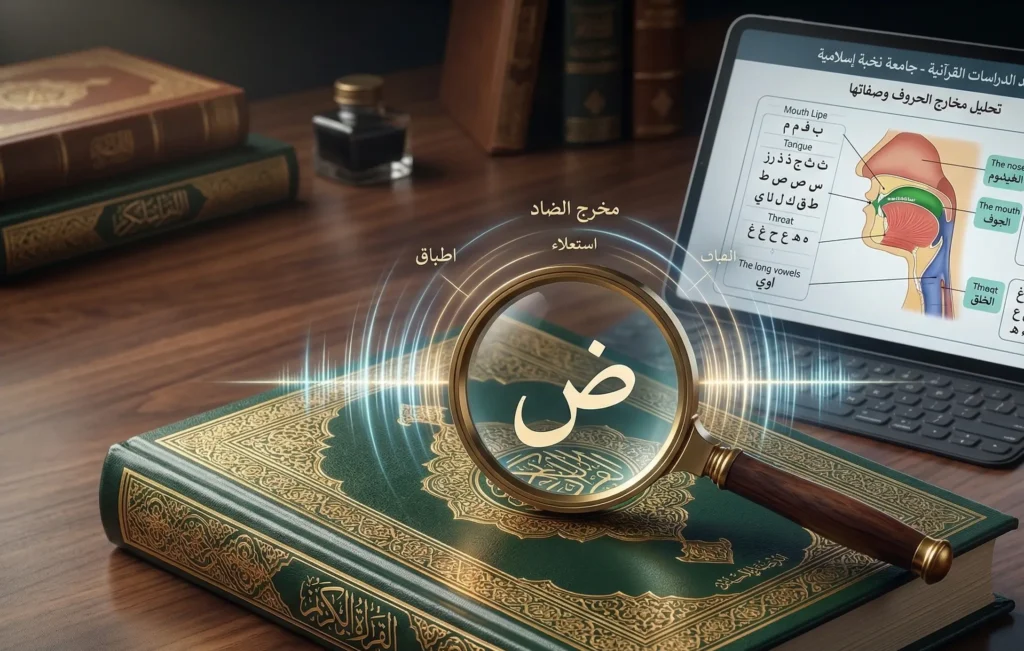
- Istitalah (Elongation): The absolute hardest characteristic in the Arabic language. It is the gradual pushing of the side of the tongue forward from the back molars to the front premolars. Applies exclusively to the ض (Daad).
(The meticulous, unbroken historical preservation of these exact, incredibly specific acoustic characteristics is documented extensively by major academic initiatives like the Corpus Coranicum at the Berlin-Brandenburg Academy of Sciences).
Devastating Mistakes You Make When Ignoring Sifat al-Huruf
Understanding the theory of sifat al-huruf is easy, but the physical application is where the vast majority of adult learners terribly stumble. You must fiercely guard against these errors:
- The “Spitting” Taa: Because the English ‘T’ is aspirated (it lets out a lot of air), students apply too much Hams (whisper) to the Arabic ت. It ends up sounding like a wet, spitting noise. The airflow must be gentle and tightly controlled.
- The Weak Heavy Letters: Failing to apply Isti’la (elevation) to the heavy letters entirely ruins the majestic tone of the Quran. If you read the word Khalidun with a flat tongue, it sounds flat, foreign, and objectively incorrect.
- Over-Bouncing the Non-Echo Letters: Because students learn Qalqalah, they accidentally start applying it to letters that have the opposite characteristic of Shiddah or Rakhawah (like bouncing the Lam or the Noon).
Comprehensive Frequently Asked Questions asked about sifat al-Huruf (FAQ)
Why are Sifat so important if I already know the Makharij? Because multiple letters share the exact same Makhraj! The ث (Thaa), ذ (Thal), and ظ (Dhaa) all emerge from the tip of the tongue touching the edges of the upper teeth. The absolute ONLY way to distinguish them is by applying their unique Sifat (like heaviness, airflow, and sound compression).
How long does it take to memorize all these characteristics? You can memorize the names of the traits in a weekend. However, physically training your tongue and vocal cords to execute a perfect Tafashshi on the Sheen or Istitalah on the Daad requires months of strict, dedicated practice with a teacher.
Can I learn these traits perfectly just by listening to an audio recording? Absolutely not. You can hear the final result, but you cannot see the internal mechanics of the Qari’s mouth. Tajweed is a strictly oral science that requires immediate, live feedback.
(This is precisely why prominent, global Islamic institutions, including Al-Azhar University, have historically and fiercely emphasized that learning the practical, oral application of Tajweed directly from an expert, certified teacher is a binding obligation).
Transform Your Recitation Instantly with Al Furqan Online
Understanding the massive theoretical framework of sifat al-huruf is like reading a manual on how to fly an airplane. It is incredibly helpful, but it will not save you when you actually sit in the pilot’s seat.
Do not make the terrible, devastating mistake of guessing your characteristics and building bad muscle memory that will take years of exhausting effort to unlearn. At Al Furqan Online, our elite, certified Hafiz tutors possess a breathtaking, flawless mastery of every single characteristic of the Arabic alphabet. Through our premium 1-on-1 live online video classes, they will act as your personal phonetic guide—molding your breath, adjusting the elevation of your tongue, and gently fixing your devastating phonetic mistakes in real-time.
ake tremendous action today. Stop guessing how to honor the words of Allah.
Stop Struggling with Your Recitation Alone
Reading detailed articles is an incredible first step, but Tajweed and Quranic memorization are strictly oral sciences. You absolutely cannot fix your pronunciation without an expert ear actively listening to you.
If you are tired of guessing your Tajweed, struggling with terrible retention, or deeply worrying about your child’s foundational Islamic education, take tremendous action today.