Table of Contents
Makharij al-Huruf: The Complete Guide to the 17 Articulation Points
Imagine trying to play a magnificent, complex musical instrument without knowing exactly where to place your fingers. No matter how much passion you have, the sound will be discordant, incorrect, and ultimately unrecognizable. The Arabic language is that magnificent instrument, and the Holy Quran is its most perfect symphony.
At the absolute foundation of Quranic recitation lies the science of Makharij al-Huruf (The Points of Articulation).
In Tajweed, a Makhraj is the specific physical location in the throat, mouth, or nose where the sound of a letter originates. If you miss the Makhraj by even a millimeter, you turn a ‘Ha’ into a ‘Haa’, or a ‘Sad’ into a ‘Sin’. This isn’t just a minor accent issue; in the eyes of Allah, it is a devastating phonetic error (Lahn Jali) that can fundamentally alter the meaning of His Divine Word.
This ultimate, incredibly comprehensive guide will brilliantly break down the anatomy of Arabic speech, categorize the 5 major areas of the body used for recitation, and detail the 17 specific points of articulation so you can achieve a spectacular, expert-level recitation today.
What is Makharij al-Huruf? The Linguistic and Technical Foundation
Linguistically, Makharij is the plural of Makhraj, which translates to “exit point” or “place of emergence.”
In the science of Tajweed, Makharij al-Huruf refers to the exact physical spot where the sound of a letter is uniquely distinguished from another. According to the absolute majority of classical scholars, including the legendary Imam Ibn Al-Jazari, there are exactly 17 specific points of articulation housed within 5 major areas of the human body.
Why is Mastering Makharij al-Huruf So Difficult for Adults?
As adults, our tongues have been “conditioned” by our native languages (English, Urdu, Bengali, etc.). We have developed deep-seated muscle memories that are often in direct conflict with Arabic phonetics. To master makharij al huruf, you must literally “re-train” the muscles in your throat and tongue. (For a fascinating, peer-reviewed study on how adult learners overcome phonetic interference in liturgical languages, research published by the Journal of Phonetics highlights the neurological effort required to map new articulation points).
The “Sukoon Test”: How to Find Your Own Makhraj Makharij al-Huruf
Before we memorize the massive lists below, you need a practical tool to test your own mouth. Classical scholars brilliantly developed “The Sukoon Test.”
If you want to know exactly where a letter originates in your mouth, follow these three simple steps:
- Place a Fatha on a Hamza (أَ).
- Place a Sukoon on the letter you want to test.
- Pronounce them together sharply, and notice exactly where your breath stops or your tongue hits.
- Test the Baa (ب): Say “Ab!” You will feel your two lips instantly smash together. That is the Makhraj.
- Test the Taa (ت): Say “At!” You will feel the tip of your tongue hit the roots of your upper front teeth.
- Test the Qaaf (ق): Say “Aq!” You will feel the very back of your tongue hit the soft roof of your mouth.
Use this test as you read through the 17 points below.
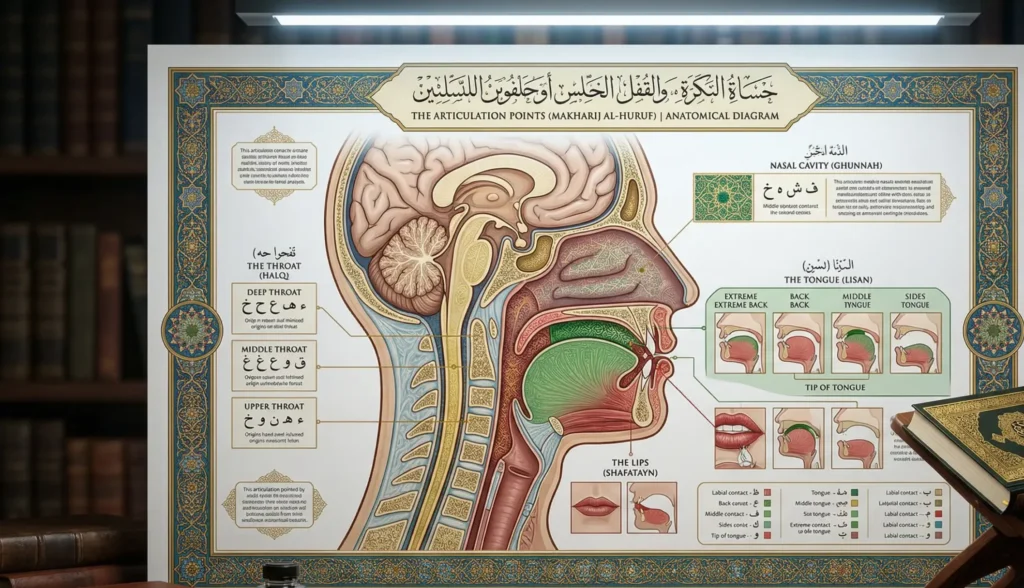
The 5 Major Areas of Articulation (Al-Makharij Al-Ammah)
Every single one of the 28 Arabic letters (and the variations of Madd) emerges from one of these 5 spectacular zones:
- Al-Jawf (The Empty Space): The internal cavity of the mouth and throat.
- Al-Halq (The Throat): The three levels of the throat.
- Al-Lisan (The Tongue): The most complex area, containing 10 specific points.
- Ash-Shafatayn (The Lips): The two lips.
- Al-Khayshoom (The Nasal Cavity): The passage leading to the nose.
The 17 Specific Points: A Step-by-Step Anatomical Breakdown of Makharij al-Huruf
Let us brilliantly explore exactly where your letters are born.
1. Al-Jawf (The Interior Empty Space)
There is 1 Makhraj here. It belongs exclusively to the three Letters of Madd (Alif, Waw, Yaa). These sounds do not rely on the tongue hitting a specific spot; they rely on the vibration of air flowing through the empty space of the mouth.
2. Al-Halq (The Throat)
The throat contains 3 specific points for 6 spectacular letters:
- Lowest Throat (Aqsa al-Halq): Nearest to the chest. Letters: ء (Hamza) and هـ (Haa).
- Middle Throat (Wasat al-Halq): The area of the epiglottis. Letters: ع (‘Ayn) and ح (Haa).
- Top Throat (Adna al-Halq): Nearest to the mouth. Letters: غ (Ghayn) and خ (Khaa).
3. Al-Lisan (The Tongue) – The “Boss” of Articulation
The tongue is the most sophisticated, highly active tool in Quranic recitation. It is a massive muscle that contains 10 specific points responsible for generating 18 distinct letters. We divide the tongue into four regions:
Region A: The Deepest Back of the Tongue (Aqsa al-Lisan)
- Point 1: The deepest back of the tongue elevating to hit the soft palate (the fleshy roof of the mouth). This produces the heavy ق (Qaaf).
- Point 2: Slightly forward from the Qaaf, the back of the tongue hits the hard palate. This produces the light ك (Kaf).
Region B: The Middle of the Tongue (Wasat al-Lisan)
- Point 3: The exact flat middle of the tongue rises to press against the roof of the mouth. This produces three letters: ج (Jeem), ش (Sheen), and the consonant ي (Yaa).
Region C: The Side of the Tongue (Hafat al-Lisan)
- Point 4: The side edges of the tongue pressing heavily against the upper molar teeth (either the left side, right side, or both simultaneously). This produces the absolute hardest letter in the Arabic language: the ض (Daad).
- Point 5: The front edges of the sides of the tongue touching the gums of the upper front premolars. This produces the ل (Lam).
Region D: The Tip of the Tongue (Taraf al-Lisan) This highly sensitive area handles the remaining points:
- Point 6: The tip of the tongue hitting the gums just behind the upper two front teeth. Produces the ن (Noon).
- Point 7: The tip of the tongue (slightly rolling inward) hitting the hard palate just behind the Noon. Produces the ر (Raa).
- Point 8: The top tip of the tongue pressing firmly against the roots (gum line) of the upper two front teeth. Produces the “Sun Letters”: ت (Taa), د (Daal), and the heavy ط (Taa).
- Point 9: The tip of the tongue lowering to gently touch the inner plates of the lower two front teeth, allowing a “whistling” sound to escape. Produces: س (Sin), ز (Zay), and the heavy ص (Sad).
- Point 10: The tip of the tongue physically protruding outward to touch the bottom edges of the upper two front teeth. Produces: ث (Thaa), ذ (Thal), and the heavy ظ (Dhaa).
4. Ash-Shafatayn (The Lips)
There are 2 specific points located at the lips, producing 4 letters:
- Point 11: The wet, inner edge of the bottom lip rising to touch the sharp edges of the upper two front teeth. Produces the ف (Faa).
- Point 12: The interaction of both lips together.
- Closing them firmly produces the م (Meem) and ب (Baa).
- Rounding them forward into a circle produces the consonant و (Waw).
5. Al-Khayshoom (The Nasal Cavity)
There is exactly 1 Makhraj here (making 17 total points).
- The Mechanics: Interestingly, this point does not produce a standalone letter. It is the exclusive exit point for the Ghunnah (the beautiful, vibrating nasal resonance) that inherently accompanies the letters Noon (ن) and Meem (م) during rules like Ikhfa and Idgham.
(The meticulous, unbroken historical preservation of these 17 specific phonetic exit points across centuries is documented extensively by major global academic initiatives, such as the Corpus Coranicum at the Berlin-Brandenburg Academy of Sciences).
Makharij vs. Sifat: Why Exit Points Are Not Enough
A brilliant student might notice a profound question: If the Taa (ت) and the heavy Taa (ط) share the exact same Makhraj (Point 8), how do we tell them apart?
This is where the secondary science of Tajweed comes in: Sifat (Characteristics). While the Makhraj tells you exactly where the sound is born, the Sifat tells you how the sound behaves. To differentiate the light Taa from the heavy Taa, you must apply the characteristic of Tafkheem (elevation of the back of the tongue) to make it heavy. Understanding makharij al huruf is only the first half of the battle; applying the correct characteristics is what creates true mastery.
Devastating Mistakes in Makharij al-Huruf (And How to Fix Them)
Even if you memorize the list, your muscle memory will try to sabotage you. You must fiercely guard against these three common, devastating errors:
- Mixing the Two ‘H’s: Beginners often use the lowest throat (هـ) for the middle throat (ح). This changes the word Al-Hamdu (All Praise) into a sound that has no meaning in Arabic.
- The “English T” Trap: In English, we pronounce the ‘T’ with the tip of the tongue hitting the ridge behind the teeth. In Tajweed, the ط (Taa) must be heavy and hit the roots of the teeth.
- The Weak ‘Daad’: Many students pronounce the ض (Daad) as a ‘D’ or a ‘Z’. This is the most unique letter in Arabic. Failing to hit its Makhraj (the side of the tongue) is a massive sign of an unrefined reciter.
Comprehensive Frequently Asked Questions about Makharij al-Huruf (FAQ)
How long does it take to master makharij al huruf? For an adult beginner, it typically takes 3 to 6 months of consistent, weekly practice with a teacher to “reset” their muscle memory. You can learn the theory in a day, but your tongue needs thousands of repetitions to build the correct physical habit.
Why does my throat hurt when I practice the letters ‘Ayn and Haa? This is very common! It means you are using muscles that have been dormant your entire life. However, if the pain is sharp, you are likely straining too hard. The middle-throat letters require a “constriction,” not a “strangulation.” A certified tutor can help you find the balance.
Can I learn Makharij just by watching YouTube videos? Absolutely not. You can see where the teacher’s tongue is, but you cannot see where your tongue is. Tajweed is an oral science that requires immediate, real-time feedback. You need someone to tell you, “Move your tongue 2 millimeters back.”
(This is precisely why prominent, global Islamic institutions, including Al-Azhar University, have historically emphasized that learning the practical, oral application of Tajweed directly from an expert, certified teacher is an absolute necessity).
Transform Your Recitation Instantly with Al Furqan Online
Understanding the theory of makharij al-huruf is like looking at a map of a city. It is helpful, but it is not the same as actually walking the streets.
Do not make the terrible, devastating mistake of building bad muscle memory that will take years of exhausting effort to unlearn. At Al Furqan Online, our elite, certified Hafiz tutors possess a breathtaking, flawless mastery of the 17 points of articulation. Through our premium 1-on-1 live online classes, they will act as your personal “Speech Pathologist” for the Quran—correcting your tongue placement, opening your throat, and gently fixing your devastating mistakes in real-time.
Take tremendous action today. Stop guessing your articulation.