Table of Contents
Heavy and Light Letters in Tajweed: A Complete Pronunciation Guide
When you listen to a master Quranic reciter, such as Sheikh Abdul Basit or Sheikh Al-Husary, you immediately notice a breathtaking, magnificent dynamic in their voice. Some letters sound incredibly sharp, crisp, and flat, while other letters sound profoundly deep, echoing, and completely fill the mouth with a spectacular resonance.
This beautiful, striking contrast is not an accident. It is the highly precise, exact science of heavy and light letters in tajweed.
In classical Arabic phonetics, this magnificent duality is known as Tafkheem (Heaviness) and Tarqeeq (Lightness). Mastering this exact science is absolutely non-negotiable for anyone who wishes to recite the glorious Quran correctly. If you make the devastating, terrible mistake of reading a heavy letter as a light letter, you can completely and tragically alter the divine meaning of the verse (a fatal error known as Lahn Jali).
This ultimate, comprehensive guide will brilliantly break down the exact anatomical mechanics of your mouth, provide a complete list of the heavy and light letters, and give you the exact, step-by-step rules to permanently fix your pronunciation today.
The Anatomy of Sound: What Makes a Letter Heavy or Light?
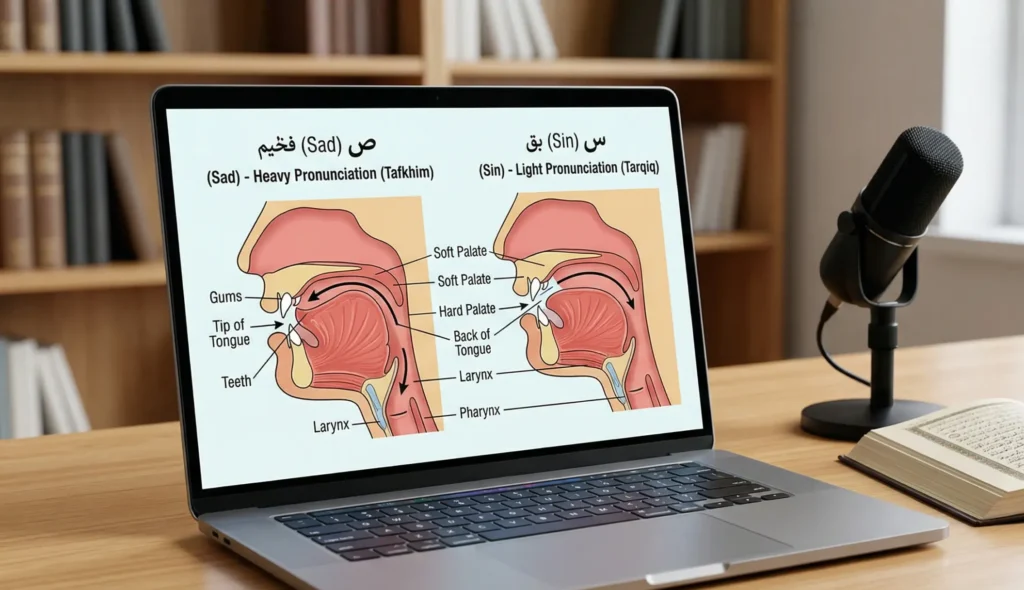
Before we memorize lists of letters, you absolutely must understand the biological physics of your own mouth. To properly execute the rules of heavy and light letters tajweed, you must master the positioning of your tongue.
The Mechanics of Tafkheem (Heaviness) in Heavy and Light Letters in Tajweed
Linguistically, Tafkheem means to fatten, thicken, or elevate. In the applied science of Tajweed, it means producing a magnificent, heavy sound that physically echoes and completely fills the oral cavity.
- How it happens: To produce a heavy letter, the absolute back of your tongue (the root) must dramatically elevate and point directly toward the soft palate (the roof of your mouth). This elevation traps the sound, forcing it to bounce around your mouth, creating a profound, thick echo.
The Mechanics of Tarqeeq (Lightness) in Heavy and Light Letters in Tajweed
Linguistically, Tarqeeq means to thin or attenuate. In Tajweed, it refers to a sharp, incredibly crisp, and flat sound.
- How it happens: To produce a light letter, the back of your tongue remains completely flat and resting at the bottom of your mouth. The sound travels straight out of the lips without any echo or thickening whatsoever.
(For a fascinating, deeply academic look at the acoustic physics of Arabic consonants, researchers in the Journal of Phonetics have extensively mapped the exact tongue elevation required for these specific phonetic sounds)
The 7 Permanently Heavy Letters (Huroof Al-Isti’la)
There are exactly seven letters in the Arabic alphabet that are absolutely, permanently heavy. It does not matter if they have a Fatha, Kasra, Damma, or Sukoon; they will always require the back of your tongue to elevate.
These seven spectacular letters are collectively known as Huroof Al-Isti’la (The Letters of Elevation). To make memorization incredibly easy, classical scholars brilliantly grouped them into a single, famous phrase:
خُصَّ ضَغْطٍ قِظْ (Khussa Daghtin Qidh)
- خ (Kha): Pronounced from the top of the throat.
- ص (Sad): The heavy, echoing version of ‘Sin’.
- ض (Daad): The most difficult letter in Arabic, requiring the side of the tongue to press against the upper molars.
- غ (Ghayn): Pronounced from the top of the throat (similar to gargling).
- ط (Taa): The heavy, echoing version of ‘Ta’.
- ق (Qaaf): Pronounced from the very back of the tongue touching the soft palate.
- ظ (Dhaa): The heavy, echoing version of ‘Thal’.
The Devastating Danger of Mispronunciation: If you fail to apply Tafkheem to these letters, you will ruin the Quranic meaning.
- If you read the heavy ص (Sad) in the word Qalb (heart) as a light س (Sin), it terribly changes the word to mean “Dog” (Kalb). This is a catastrophic error that absolutely must be fixed by a certified tutor immediately.
The 5 Levels of Heaviness
Not all heavy letters are equally heavy. The brilliant scholar Ibn Al-Jazari established that the intensity of the heaviness strictly depends on the vowel (Harakat) attached to the letter:
- Strongest: Heavy letter with a Fatha, followed by an Alif (e.g., قَال).
- Second: Heavy letter with a Fatha only (e.g., قَدْ).
- Third: Heavy letter with a Damma (e.g., يَقُول).
- Fourth: Heavy letter with a Sukoon (e.g., يَقْطَع).
- Weakest: Heavy letter with a Kasra (e.g., قِيل). Even at its weakest, it is still technically heavy and must never sound like a light ‘Kaf’.
The Permanently Light Letters (Huroof Al-Istifal)
The vast majority of the Arabic alphabet falls into this category. These letters are completely, permanently light. The back of your tongue must stay brutally flat.
The permanently light letters are: ب, ت, ث, ج, ح, د, ذ, ز, س, ش, ع, ف, ك, م, ن, هـ, و, ي
When reading these letters, your mouth should be relaxed. Do not artificially puff out your cheeks or round your lips (unless there is a Damma). A common, terrible mistake beginners make is accidentally making a light letter heavy simply because it is sitting next to a heavy letter in a word. You must fiercely isolate the light sound!
The 3 Chameleon Letters (Sometimes Heavy, Sometimes Light)
This is where the science of heavy and light letters tajweed becomes incredibly complex and breathtakingly beautiful. There are exactly three letters that constantly change their state based on highly specific surrounding conditions.
1. The Alif (ا)
The Alif is an incredibly submissive letter. It has absolutely no independent characteristic of its own. It simply mirrors the exact state of the letter that immediately precedes it.
- Heavy Alif: If the letter before the Alif is heavy, the Alif becomes spectacularly heavy and echoes. (Example: قَالَ – Qaala. The Alif takes the heavy resonance of the Qaaf).
- Light Alif: If the letter before the Alif is light, the Alif becomes completely flat and light. (Example: كَانَ – Kaana. The Alif stays light because of the Kaf).
2. The Lam (ل) in the Name of Allah
The letter Lam is generally a permanently light letter in the Arabic language. However, there is one magnificent, exclusive exception: the Lam inside the majestic name of Allah (اللّٰه).
- Heavy Lam (Tafkheem): If the word immediately preceding the name “Allah” ends with a Fatha or a Damma, the Lam in “Allah” becomes incredibly thick, heavy, and profound. (Example: Rasoolu-llah or Huw-Allah).
- Light Lam (Tarqeeq): If the word immediately preceding the name “Allah” ends with a Kasra, the Lam remains beautifully flat, sharp, and light. (Example: Bismillah).
3. The Highly Complex Rules of Raa (ر)
The letter Raa is the absolute ultimate test of a student’s Tajweed. It flips between heavy and light based on an incredibly strict, complex set of physical rules.
When the Raa is Heavy (Tafkheem):
- When the Raa carries a Fatha or Damma.
- When the Raa carries a Sukoon, and the letter immediately before it has a Fatha or Damma.
- When the Raa carries a Sukoon, the letter before it has a Sukoon, and the letter before that has a Fatha or Damma.
- When the Raa carries a Sukoon, and it is followed by one of the 7 Heavy Letters (Khussa Daghtin Qidh) in the exact same word. (Example: مِرْصَادًا).
When the Raa is Light (Tarqeeq):
- When the Raa carries a Kasra.
- When the Raa carries a Sukoon, and the letter immediately before it has an original Kasra.
- When stopping on a Raa, the letter before it is a Yaa (ي) with a Sukoon.
(For an exhaustive, classical breakdown of these highly intricate rules, the legendary text Al-Muqaddimah Al-Jazariyyah remains the absolute, undisputed authority in the Islamic world).
Frequently Asked Questions (FAQ) for Beginners
Why do my light letters sound heavy when I read fast? This is the most common, devastating mistake. When a light letter (like ‘M’) is placed directly next to a heavy letter (like ‘Saa’), the lazy human tongue wants to elevate early. You must actively, forcefully drop the back of your tongue for the light letter, and only raise it exactly when the heavy letter begins.
Do I need to round my lips to make a letter heavy? Absolutely not! This is a terrible, terrible habit. Tafkheem (Heaviness) comes exclusively from the back of the tongue echoing against the roof of the mouth, not from protruding your lips like a fish. Lip rounding is only for the Damma vowel or the letter Waw.
Can I learn these rules just by reading a book? No. Tajweed is an incredibly precise, entirely oral science. A book can give you the theory, but you absolutely cannot see the back of your own tongue. You will inevitably make disastrous mistakes without realizing it.
The Absolute Necessity of a Certified Online Tutor
Understanding the theoretical rules of heavy and light letters in tajweed is only 10% of the battle. The other 90% is the intense, physical muscle memory of your tongue, throat, and jaw.
If you try to practice these incredibly complex rules completely alone, you will inevitably develop terrible, irreversible pronunciation habits. You absolutely must have a certified, expert ear listen to your specific oral cavity dynamics and correct your devastating mistakes in real-time.
At Al Furqan Online, we specialize brilliantly in correcting the terrible phonetic mistakes of adult beginners. Our elite, highly patient tutors hold prestigious Ijazahs and possess an absolutely flawless mastery of Tafkheem and Tarqeeq. They will gently, perfectly guide your tongue to the exact right position, completely transforming your daily recitation.
Take tremendous action today. Stop guessing your pronunciation. Book a spectacular, completely free trial class with Al Furqan Online today, and master the magnificent art of heavy and light letters forever.