
Table of Contents
Rules of Noon Sakinah and Tanween: The Complete Tajweed Guide
If you have ever listened to a magnificent, breathtaking recitation of the Holy Quran and wondered how the reciter seamlessly blends words together, creates beautiful echoing nasal sounds, and flows effortlessly through the Arabic text, you are witnessing the absolute magic of Tajweed.
At the very heart of this spectacular rhythm is one foundational concept: the rules of noon sakinah and tanween.
For beginners, this is often the most terribly confusing part of learning to read the Quran. You will see an ‘N’ sound, but sometimes you pronounce it clearly, sometimes you completely hide it, sometimes you merge it into the next letter, and sometimes you miraculously change it into an ‘M’!
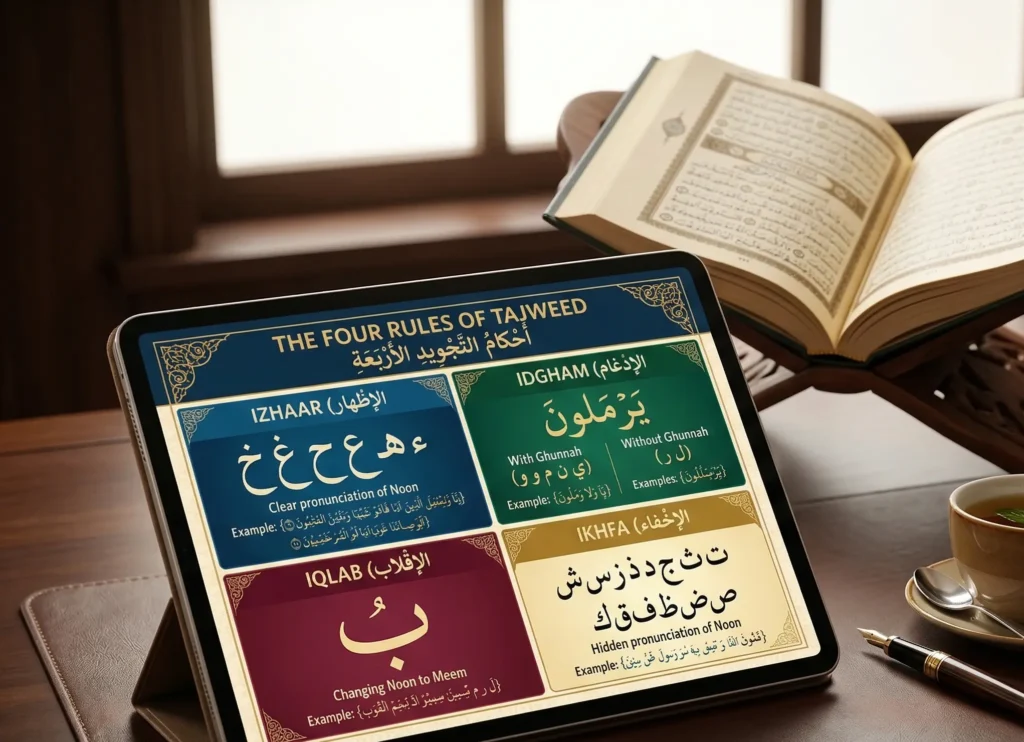
If you do not master these four strict, non-negotiable rules, your recitation will sound incredibly chaotic, broken, and incorrect. This ultimate, comprehensive encyclopedic guide will brilliantly break down the exact mechanics of Izhaar, Idgham, Iqlab, and Ikhfa, complete with crystal-clear Arabic examples so you can completely transform your recitation today.
What is a Noon Sakinah and a Tanween?
Before we dive into the spectacular rules, we absolutely must define our core terms.
1. Noon Sakinah (نْ)
A Noon Sakinah is simply the Arabic letter Noon (ن) that carries a Sukoon (a small resting symbol that looks like a tiny circle or a crescent). It has absolutely no vowel attached to it—no Fatha, no Kasra, and no Damma. It is a pure, resting ‘N’ sound.
2. Tanween (ً ٍ ٌ )
A Tanween is the double vowel marking found at the absolute end of Arabic words (Fathatayn, Kasratayn, or Dammatayn). Here is the spectacular secret of Tajweed: A Tanween is mathematically and phonetically identical to a Noon Sakinah. When you say the word Kitabun (كِتَابٌ), you are ending the word with an ‘N’ sound, even though the letter Noon is not physically written. Because they produce the exact same phonetic ‘N’ sound, the rules that apply to them are exactly the same.
(For a fascinating, peer-reviewed analysis of the acoustic physics behind these specific nasal consonants, researchers in the Journal of Speech, Language, and Hearing Research have extensively mapped how the human vocal tract produces these complex resonant sounds).
The 4 Magnificent Rules of Noon Sakinah and Tanween
Whenever you encounter a Noon Sakinah or a Tanween in the glorious Quran, you must immediately look at the very next letter. That following letter acts as a strict “trigger” that tells you exactly which of the four rules to apply.
Rule 1: Izhaar (Clear Pronunciation)
Linguistically, Izhaar means “to make clear” or “to reveal.” The Rule: If a Noon Sakinah or Tanween is followed by any of the six Throat Letters (Huroof Al-Halqi), you must pronounce the ‘N’ sound with absolute, brilliant clarity. There is no extra stretching, no merging, and no holding of the sound.
The 6 Trigger Letters for Izhaar: These letters all originate from the throat: ء , هـ , ع , ح , غ , خ (Hamza, Haa, ‘Ayn, Haa, Ghayn, Khaa).
Spectacular Examples:
- مِنْ خَوْفٍ (Min Khawf): The Noon is followed by a Kha. You clearly say the ‘N’.
- عَذَابٌ عَظِيمٌ (‘Athaabun ‘Azeem): The Tanween is followed by an ‘Ayn. You clearly pronounce the ‘N’ sound of the Tanween.
Rule 2: Idgham (Merging and Blending)
Linguistically, Idgham means “to insert one thing into another.” This is what gives the Quran its breathtaking, flowing rhythm. The Rule: If a Noon Sakinah or Tanween is followed by any of the six Idgham letters, the ‘N’ sound is completely swallowed and seamlessly merged into the following letter.
The 6 Trigger Letters for Idgham: Classical scholars brilliantly grouped these letters into one easy-to-remember word: يَرْمَلُون (Yarmaloon). The letters are: ي , ر , م , ل , و , ن.
However, Idgham is split into two highly specific categories:
A. Idgham with Ghunnah (Merging with a Nasal Sound) Trigger Letters: ي , ن , م , و (Yanmoo) When merging into these letters, you must hold a beautiful, vibrating nasal sound (Ghunnah) for exactly 2 beats (Harakat).
- مِنْ مَسَدٍ (Mim-masad): The Noon merges into the Meem. You hold the ‘M’ sound for 2 counts through your nose.
B. Idgham without Ghunnah (Merging without a Nasal Sound) Trigger Letters: ل , ر (Lam and Raa) When merging into these letters, the ‘N’ disappears completely, and you immediately and sharply pronounce the Lam or Raa without any extra nasal holding.
- مِنْ رَبِّهِمْ (Mir-rabbihim): The Noon completely vanishes into the heavy Raa.
Rule 3: Iqlab (The Conversion)
Linguistically, Iqlab means “to turn over” or “to alter.” The Rule: If a Noon Sakinah or Tanween is followed by the letter ب (Baa), the ‘N’ sound is completely and miraculously transformed into a hidden م (Meem) sound. You must also hold a beautiful nasal Ghunnah for 2 beats while leaving a microscopic gap between your lips.
The 1 Trigger Letter for Iqlab: The letter ب (Baa). In most printed Mushafs, the calligraphers make this incredibly easy by placing a tiny little ‘م’ over the Noon.
Spectacular Examples:
- مِنْ بَعْدِ (Mim-ba’di): You do not say “Min ba’di”. You convert the ‘N’ to an ‘M’ and hold it.
- سَمِيعٌ بَصِيرٌ (Samee’um-Baseer): The Tanween meets the Baa and converts into an ‘M’.
Rule 4: Ikhfa (Hiding and Concealing)
Linguistically, Ikhfa means “to hide” or “to conceal.” This is the most common rule in the entire Quran, and the most difficult for beginners to master perfectly. The Rule: If a Noon Sakinah or Tanween is followed by any of the remaining 15 letters of the Arabic alphabet, you must hide the ‘N’ sound.
How to physically perform Ikhfa: You do not pronounce the ‘N’ clearly (like Izhaar), nor do you completely merge it (like Idgham). Instead, your tongue hovers in the empty space of your mouth, ready to pronounce the next letter, while you emit a beautiful, 2-beat nasal Ghunnah through your nose.
The 15 Trigger Letters for Ikhfa: ت , ث , ج , د , ذ , ز , س , ش , ص , ض , ط , ظ , ف , ق , ك
Spectacular Examples:
- مِنْ شَرِّ (Min-sharri): The tongue prepares for the ‘Sh’ sound while holding the nasal tone.
- أَنْزَلَ (Anzala): The tongue prepares for the ‘Z’ sound.
(The meticulous, unbroken historical preservation of these highly specific phonetic rules across centuries is documented extensively by major academic initiatives like the Corpus Coranicum at the Berlin-Brandenburg Academy of Sciences).
Even when adult students memorize the theory, they often make terrible, destructive mistakes in their practical application. You must fiercely guard against these terrible habits:
Closing the Lips tightly on Ikhfa: During Ikhfa, the sound must come out of the nose, but the mouth must remain open. If you close your lips, you accidentally create an ‘M’ sound, which ruins the word.
Bouncing the Noon (Qalqalah): The letter Noon is absolutely NOT a bouncing letter. When pronouncing an Izhaar, many beginners terribly bounce the ‘N’ (e.g., saying Min-uh instead of Min). This is a devastating error.
Rushing the Ghunnah: Whether you are doing Idgham, Iqlab, or Ikhfa, the nasal sound must be held for a full, magnificent 2 counts (Harakat). Cutting it short completely destroys the majestic rhythm of the verse.
Comprehensive Frequently Asked Questions (FAQ)
To make this the absolute most definitive, encyclopedic guide on the internet, we have compiled the most highly searched questions students ask regarding the rules of noon sakinah and tanween.
Why do I sometimes see a Shaddah (ّ) after a Noon Sakinah? That is a brilliant visual clue! When the calligraphers of the Quran want to visually tell you that an Idgham (Merge) is happening, they often place a Shaddah on the following letter to remind you to merge the sound heavily.
Does Ikhfa sound the same for every letter? No! This is a spectacular secret of Tajweed. The Ghunnah (nasal sound) of the Ikhfa actually changes depending on the letter that follows it. If the following letter is heavy (like ص or ط), the nasal sound must also become incredibly heavy and thick. If the following letter is light (like ت or ف), the nasal sound remains sharp and light.
What happens if I stop on a word ending with a Tanween? If you stop to take a breath on a word ending with Fathatayn (ً ), you drop the ‘N’ sound completely and stretch the Alif for 2 counts (this is called Madd Iwad). If you stop on Kasratayn (ٍ ) or Dammatayn (ٌ ), you drop the ‘N’ sound and place a temporary Sukoon on the final letter.
Why You Absolutely Cannot Learn This From a Book
You can read this encyclopedic guide ten times and memorize every single trigger letter perfectly. However, Tajweed is an inherently, strictly oral science.
When it comes to the rules of noon sakinah and tanween, human beings are notoriously terrible at judging their own nasal resonance. A beginner trying to hold a 2-count Ikhfa will often place their tongue in the exact wrong position, creating a terrible muffled sound instead of a beautiful hidden ‘N’.
(This is precisely why prominent, global Islamic institutions, including Al-Azhar University, have historically emphasized that learning the practical, oral application of Tajweed directly from an expert, certified teacher with an unbroken chain of transmission (Sanad) is an absolute necessity).
Transform Your Recitation Instantly with Al Furqan Online
At Al Furqan Online, we specialize brilliantly in taking completely overwhelmed adult beginners and transforming them into confident, beautiful reciters.
Do not make the terrible, devastating mistake of guessing your pronunciation and building bad habits that will take years to unlearn. Our elite, certified Hafiz tutors possess a breathtaking, flawless mastery of Izhaar, Idgham, Iqlab, and Ikhfa. Through our premium 1-on-1 live online classes, they will act as your personal audio guide, correcting the exact placement of your tongue, adjusting your nasal resonance, and gently fixing your devastating mistakes in real-time.
Take tremendous action today. Stop struggling with the complex rules of the Quran. Book a spectacular, completely free trial class with Al Furqan Online today, and master the magnificent art of Tajweed forever.
Pingback: How to Read Quran with Tajweed:#1 Ultimate Beginner Guide