
Table of Contents
Types of Madd in Quran: The Complete Rules and Examples Guide
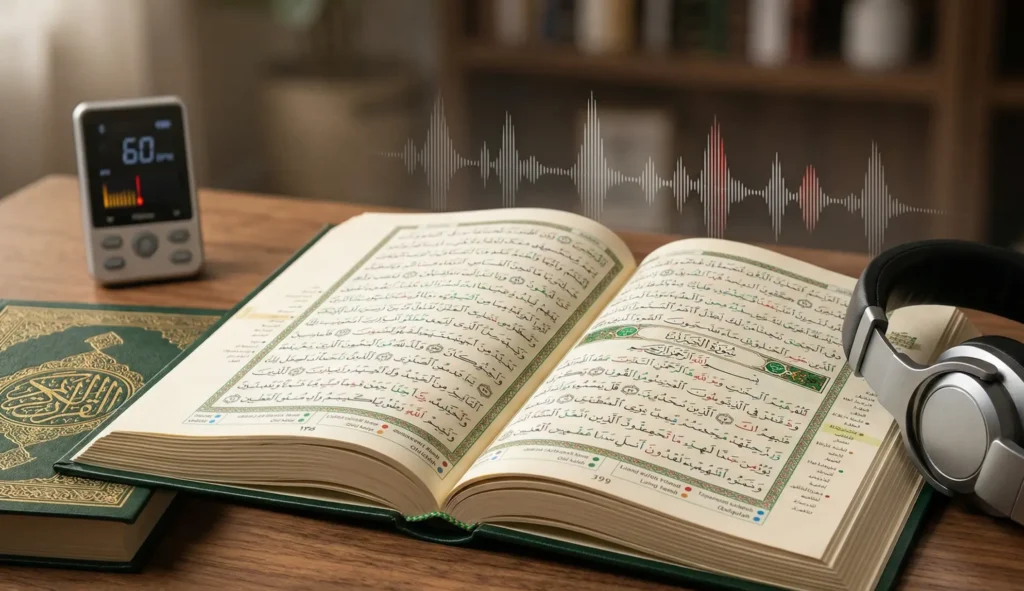
When you listen to the breathtaking, soul-stirring recitation of a master Qari (reciter) like Sheikh Mishary Alafasy or Sheikh Abdul Basit, what instantly captures your heart is not just the clarity of their letters, but the magnificent, flowing rhythm of their voice. The way they beautifully stretch certain words, hold specific vowels, and pause with perfect timing is what gives the Quran its miraculous, unparalleled auditory beauty.
This spectacular rhythm is completely governed by the highly precise science of Madd (Elongation).
If you do not understand the different types of madd in quran, your recitation will sound incredibly rushed, completely flat, and chaotic. Worse, if you stretch a word in the wrong place, or fail to stretch it when required, you can terribly alter the divine meaning of the verse (a fatal error known as Lahn Jali).
This ultimate, comprehensive guide will brilliantly break down the exact science of Madd, explain the exact timing (Harakat) you must use, and provide crystal-clear Arabic examples so you can perfectly master your recitation today.
What is Madd? Understanding the Foundation _ TYPES OF MADD IN QURAN
Linguistically, the Arabic word Madd (المد) means “to stretch,” “to prolong,” or “to elongate.” In the highly applied science of Tajweed, Madd is the magnificent prolongation of the sound of a vowel for a specific, strictly measured duration.(For a fascinating, peer-reviewed analysis on the exact acoustic duration and physics of these specific vowels, research published by the Journal of the Acoustical Society of America highlights the breathtaking mathematical precision of expert Quranic reciters).
To perform any type of Madd, you absolutely must have one of the three Letters of Madd (Huroof Al-Madd). These letters are the engine of all elongation in the Quran:
- Alif (ا): Must be preceded by a letter with a Fatha (ـَ). (Example: قَا)
- Waw (و): Must have a Sukoon (resting state) and be preceded by a letter with a Damma (ـُ). (Example: قُو)
- Yaa (ي): Must have a Sukoon and be preceded by a letter with a Kasra (ـِ). (Example: قِي)
The Measurement of Time: What is a “Harakah”?
In Tajweed, the length of a stretch is measured in Harakat (counts or beats).
- 1 Harakah: The time it takes to normally pronounce a single short vowel (like saying “Ba”). Alternatively, scholars describe it as the time it takes to comfortably open or close a single finger.
- 2 Harakat: Doubling that time (like saying “Baa”).
The science of Madd dictates whether a vowel is stretched for 2, 4, 5, or 6 complete counts.
TYPES OF MADD IN QURAN
Category 1: Madd Asli (The Natural Elongation)
The absolute foundational level of elongation is called Madd Asli (The Original/Natural Madd), also known as Madd Tabee’i.
The Rule: If a Madd letter (Alif, Waw, or Yaa) appears in a word, and it is NOT immediately followed by a Hamza (ء) or a Sukoon (ْ ), it is a Natural Madd. The Timing: It must absolutely be stretched for exactly 2 Harakat (counts).
You cannot stretch it for 1 count, nor can you stretch it for 3 counts. It must be a perfect, precise double-beat. If you drop the Madd Asli, you completely destroy the word.
Spectacular Examples of Madd Asli:
- قَالَ (Qaala – He said): The Alif is preceded by a Fatha. Stretch for 2 counts.
- يَقُولُ (Yaqoolu – He says): The Waw is preceded by a Damma. Stretch for 2 counts.
- قِيلَ (Qeela – It was said): The Yaa is preceded by a Kasra. Stretch for 2 counts.
TYPES OF MADD IN QURAN
Category 2 Madd Far’i (The Derived Elongation)
This is where the magnificent complexity of Tajweed begins. Madd Far’i (Derived Madd) occurs when a Natural Madd is fundamentally altered because it meets a specific “trigger.”
There are only two triggers that force a Madd to stretch beyond the natural 2 counts:
- The presence of a Hamza (ء)
- The presence of a Sukoon (ْ ) or Shaddah (ّ )
Let us brilliantly break down the exact types of madd in quran created by these specific triggers. (The meticulous, unbroken historical preservation of these specific elongation rules across centuries is documented extensively by major academic initiatives like the Corpus Coranicum at the Berlin-Brandenburg Academy of Sciences).
TYPES OF MADD IN QURAN
Types of Madd in QuranTriggered by a Hamza (ء)
When a Madd letter collides with a Hamza, it creates highly specific, beautiful elongations.
1. Madd Muttasil (Obligatory Connected Elongation)
The Rule: This occurs when a Madd letter and a Hamza appear in the exact same word. Because they are connected in one word, this stretch is Wajib (obligatory) for all reciters. The Timing: Must be stretched for 4 or 5 Harakat. (If stopping on the word, it can be stretched to 6). Examples:
- سَمَاء (Samaaa’ – Sky): The Alif is followed by a Hamza in the same word.
- سِيءَ (Seeee’a – Was made evil): The Yaa is followed by a Hamza.
- سُوء (Soooo’ – Evil): The Waw is followed by a Hamza.
2. Madd Munfasil (Permissible Disconnected Elongation)
The Rule: This occurs when a Madd letter is at the absolute end of one word, and the Hamza is at the absolute beginning of the very next word. Because they are separated, it is Ja’iz (permissible) to stretch it. The Timing: Can be stretched for 4 or 5 Harakat (though some advanced Qira’at allow 2 counts, standard Hafs recitation utilizes 4 or 5). Examples:
- إِنَّا أَعْطَيْنَاكَ (Innaaa A’taynak – Indeed, We have given you): The Alif is at the end of “Inna,” and the Hamza begins “A’taynak.”
- فِي أَنْفُسِكُمْ (Feeee Anfusikum – In yourselves).
3. Madd Badal (The Substitute Elongation)
The Rule: This is a spectacular reversal. Instead of the Madd letter coming first, the Hamza comes first, immediately followed by a Madd letter. The Timing: It is stretched for exactly 2 Harakat (in the standard Hafs recitation). Examples:
- آمَنُوا (Aamanu – They believed): Originally two Hamzas, changed to a Hamza followed by an Alif.
- إِيمَانًا (Eemaanan – Faith): Hamza followed by a Yaa.
- أُوتُوا (Ootoo – They were given): Hamza followed by a Waw.
Types of Madd in Quran Triggered by a Sukoon (ْ )
When a Madd letter is followed by a letter that carries a Sukoon (either permanent or temporary), the elongation becomes incredibly profound.
4. Madd Lazim (The Compulsory Elongation)
This is the absolute longest, heaviest, and most magnificent stretch in the entire Quran. The Rule: This occurs when a Madd letter is followed by an original, permanent Sukoon (or a Shaddah, which contains a hidden Sukoon) in the exact same word or letter. The Timing: It must absolutely, compulsorily be stretched for exactly 6 Harakat.
- Madd Lazim Kalimi Muthaqqal (Heavy Word Compulsory): Occurs in a word when followed by a Shaddah.
- Example: الضَّالِّينَ (Ad-Daaallleen – Those who go astray). The Alif is followed by a Lam with a Shaddah. You must hold the ‘A’ for 6 full beats before hitting the Lam.
- Example: الْحَاقَّةُ (Al-Haaaqqah – The Inevitable Reality).
- Madd Lazim Harfi (Letter Compulsory): Occurs in the magnificent, mysterious disjointed letters (Huroof Muqatta’at) at the beginning of certain Surahs.
- Example: الم (Alif-Laaam-Meeem). The Lam and Meem are stretched for 6 counts each.
Madd Aridh li-Sukun (Temporary Elongation for Stopping)
This is the most common, beautiful stretch you hear at the end of verses. The Rule: This occurs when you decide to stop on a word. By stopping, you place a “temporary Sukoon” on the final letter. If the letter immediately before that final letter is a Madd letter, you trigger this rule. The Timing: You have the magnificent choice of stretching it for 2, 4, or 6 Harakat. However, you must remain consistent with your choice throughout your recitation. Example:
- الْعَالَمِينَ (Al-‘Aalameen – The worlds). If you continue reading, the Yaa is only 2 counts. But because it is the end of Surah Fatihah and you stop, you stretch the Yaa for 2, 4, or 6 counts before pronouncing the final ‘N’ sound.
6. Madd Lin (The Elongation of Softness)
The Rule: This is very similar to Madd Aridh, but it involves the “Letters of Lin.” These are a Waw (و) or Yaa (ي) with a Sukoon, but preceded by a Fatha (not a matching vowel). This only occurs when you stop on the word. The Timing: Can be stretched for 2, 4, or 6 Harakat. Example:
- قُرَيْشٍ (Quraysh). The Yaa has a Sukoon and is preceded by a Ra with a Fatha. When stopping on the word, you beautifully stretch the “ay” sound for 2, 4, or 6 counts.
- خَوْفٍ (Khawf). The Waw has a Sukoon preceded by a Kha with a Fatha.
The Devastating, Common Mistakes Beginners Make With types of Madd in Quran
Even when students understand the theory, they often make terrible, destructive mistakes in their practical application. You must fiercely guard against these habits:
- Rushing the Madd Asli: The most devastating mistake is treating a 2-count Madd like a 1-count short vowel. If you read “Qala” instead of “Qaala”, you completely change the Arabic grammar.
- Inconsistent Madd Aridh: You cannot read one verse ending with a 2-count stretch, and the next verse ending with a 6-count stretch. This destroys the majestic symmetry of the Quran. If you choose 4 counts, you must use 4 counts for every single stop in that sitting.
- Nasalizing the Madd (Ghunnah in the Jawf): The sound of a Madd must come purely from the empty space of the mouth and throat (Al-Jawf). Many beginners terribly push the sound into their nose, creating a nasal ‘Ghunnah’ sound on their Alif or Waw. This is a massive phonetic error.
Comprehensive Frequently Asked Questions (FAQ) About Types of Madd in Quran
To make this the absolute most definitive, encyclopedic guide on the internet, we have compiled the most highly searched, deeply anxious questions students ask regarding the types of madd in quran.
How do I actually measure a ‘Harakah’ with my fingers in real-time? Classical scholars used the folding or unfolding of a single finger to measure one Harakah. However, practically, you should think of a Harakah as a steady, rhythmic heartbeat. A 4-count Madd (like Madd Muttasil) should last exactly twice as long as a 2-count Madd Asli. Do not tap your fingers frantically; internalize a steady, majestic metronome in your mind.
What happens if I run out of breath during a massive 6-count Madd Lazim? This is an incredibly common fear for beginners! If you do not have the lung capacity to hit the 6 counts, you must absolutely stop your recitation before the word, take a massive, deep breath, and then begin the word with full lung capacity. Never cut a Madd Lazim down to 3 counts just because you are tired.
Do I have to stretch Madd Aridh for 6 counts to sound professional? Absolutely not. While 6 counts sounds incredibly dramatic and emotional (often used in the slow Tahqeeq style of reading), 4 counts is the highly recommended, perfectly balanced standard for daily Tarteel recitation.
What is the actual difference between Madd Lin and Madd Aridh? They operate on the exact same logic (stopping on a word), but the letters are different. Madd Aridh uses the standard Madd letters (Alif, Waw, Yaa with matching vowels). Madd Lin only uses Waw and Yaa that have a Sukoon and are preceded by a Fatha (creating an “aw” or “ay” sound).
Why do different Imams stretch words differently in Taraweeh? If you hear an Imam stretching words that you wouldn’t normally stretch, they might be reciting in a completely different Qira’at (such as Warsh ‘an Nafi’, which has completely different, much longer Madd rules than the standard Hafs ‘an ‘Asim). Additionally, Imams reading at a fast speed (Hadr) will mathematically have shorter Harakat than an Imam reading slowly.
The Ultimate Audio Guide: Why You Cannot Learn TYPES OF MADD IN QURAN Completely Alone
You can read this encyclopedic guide ten times and memorize every single rule perfectly. However, Tajweed is an inherently, strictly oral science.
When it comes to the types of madd in quran, human beings are notoriously terrible at keeping a perfect internal metronome. A beginner trying to hold a 4-count Madd will often rush it to 2.5 counts, or completely lose their breath and panic on a 6-count Madd Lazim.
You absolutely cannot master the magnificent rhythm of the Quran by simply reading a blog post or watching a generic, unverified YouTube video. You need an expert, elite ear to act as your personalized audio guide.
You need an expert, elite ear to act as your personalized audio guide. (This is why prominent, global Islamic institutions, including Dar al-Ifta al-Missriyyah, have historically emphasized that learning the practical, oral application of Tajweed directly from an expert teacher is a binding obligation).
Transform Your Recitation Instantly with Al Furqan Online
At Al Furqan Online, we specialize brilliantly in taking completely overwhelmed adult beginners and transforming them into confident, beautiful reciters.
Do not make the terrible, devastating mistake of guessing your timing and building bad habits. Our elite, certified Hafiz tutors possess a breathtaking, flawless mastery of Madd. Through our premium 1-on-1 live online classes, they will act as your personal audio guide, tapping out the exact Harakat, dramatically adjusting your breath control, and gently fixing your devastating mistakes in real-time.
Take tremendous action today. Stop struggling with the complex rhythm of the Quran. Book a spectacular, completely free trial class with Al Furqan Online today, and master the magnificent art of elongation forever.
Pingback: How to Read Quran with Tajweed:#1 Ultimate Beginner Guide